How to Recognize Stroke Warning Signs and Symptoms Needing Urgent Care
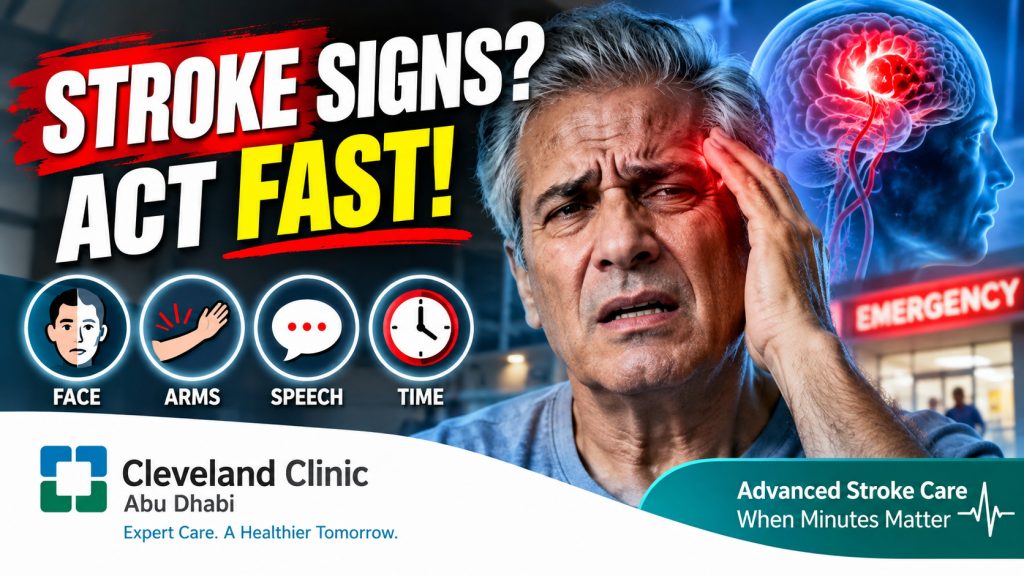
A distressed middle-aged man grips his temple in front of an emergency room entrance, illustrating acute brain stroke symptoms and the need for immediate medical intervention. High-contrast clinical lighting emphasizes the pained facial expression alongside a glowing neurological brain overlay and the FAST diagnostic icons. Educational healthcare graphic detailing brain stroke symptoms and the FAST response protocol.
Stroke symptoms can appear without warning, and knowing what to look for can make a critical difference. A sudden facial droop, weakness in one arm, trouble speaking, vision changes, dizziness, or loss of balance may signal that the brain is not receiving enough blood or oxygen. These symptoms should never be watched at home to see whether they improve. Cleveland Clinic Abu Dhabi emphasizes B.E. F.A.S.T. as a simple way to recognize the key signs of stroke and act quickly. stroke symptoms
If stroke symptoms occur, time matters. Rapid assessment can help doctors determine whether the stroke is caused by a blocked blood vessel or bleeding and whether emergency treatment may be appropriate. In the UAE, call 998 for an ambulance during a medical emergency.
TL DR: Stroke symptoms usually begin suddenly. The most important warning signs include facial drooping, weakness or numbness in an arm or leg, speech problems, sudden vision changes, dizziness, loss of balance, confusion, and sometimes a severe headache with no known cause. The B.E. F.A.S.T. method helps people remember Balance, Eyes, Face, Arms, Speech, and Time. If any of these signs appear, treat the situation as an emergency. Do not wait for symptoms to disappear and do not drive the person yourself if an ambulance is available. Note the time the symptoms started, call the local emergency service, and follow the instructions given by emergency professionals. Even symptoms that disappear can indicate a transient ischemic attack, or TIA, which also requires urgent medical assessment.
Quick summary: Sudden changes in balance, vision, facial movement, arm strength, or speech can be signs of stroke. Act immediately rather than waiting for symptoms to improve.
Quick Answer: The most common stroke warning signs are sudden facial drooping, weakness or numbness on one side of the body, difficulty speaking or understanding speech, vision changes, dizziness, loss of balance, and unexplained severe headache. Use B.E. F.A.S.T. to remember the signs. If any appear, call 998 for an ambulance in the UAE and seek emergency care immediately.
What are stroke symptoms?
Stroke symptoms are sudden changes in neurological function caused by an interruption of blood flow to part of the brain or bleeding from a blood vessel in the brain. Depending on the area affected, a person may develop weakness, numbness, speech difficulties, vision problems, confusion, dizziness, or problems with balance and coordination. Because symptoms can vary from one person to another, any sudden unexplained neurological change should be treated seriously and assessed urgently.
What Is a Stroke?
A stroke happens when part of the brain suddenly loses its normal blood supply or when a blood vessel in the brain ruptures and causes bleeding. Without adequate oxygen and nutrients, brain tissue can become damaged.
There are two major types.
Ischemic stroke
An ischemic stroke occurs when a blood vessel supplying the brain becomes blocked. A blood clot may form in an artery supplying the brain, or a clot may travel from another part of the body and become lodged in a brain artery.
This is the most common type of stroke.
Hemorrhagic stroke
A hemorrhagic stroke occurs when a blood vessel in the brain ruptures and bleeds. The bleeding can damage surrounding brain tissue and increase pressure within the skull.
Both types require urgent medical attention. The symptoms may look similar at first, so a person experiencing possible stroke symptoms should not try to determine the type of stroke at home. Medical professionals need to assess the patient and use appropriate brain imaging to establish the diagnosis.
Key point: You cannot reliably determine the type of stroke from symptoms alone. Sudden neurological changes require emergency assessment.
The Main Signs of Stroke
Recognizing the main signs of stroke is easier when you know what changes to watch for.
1. Sudden facial drooping
One side of the face may become weak or numb. The person’s smile may look uneven, or one side of the mouth may appear to droop.
Ask the person to smile if they are able to respond.
2. Sudden arm weakness
One arm may suddenly become weak, numb, or difficult to control. When the person raises both arms, one may drift downward.
Weakness can also affect a leg or one entire side of the body.
3. Sudden speech difficulty
A person having a stroke may:
- Slur their words
- Have difficulty finding words
- Say something that does not make sense
- Struggle to understand what others are saying
- Become unable to speak normally
Speech changes can be particularly noticeable when they happen suddenly.
4. Sudden vision problems
Stroke can cause sudden changes in vision in one or both eyes. These may include blurred vision, double vision, or loss of vision.
A sudden visual disturbance should not be dismissed as ordinary tiredness, especially when it occurs alongside other neurological symptoms.
5. Sudden dizziness or loss of balance
A person may suddenly become unsteady, have difficulty walking, feel dizzy, or lose coordination.
Balance problems can be especially important when they appear suddenly and occur with vision changes, weakness, or speech problems.
6. Sudden severe headache
A sudden, severe headache with no known cause can be a warning sign of stroke, particularly when associated with other neurological symptoms. A severe headache should receive urgent medical assessment when it is sudden, unusual, or accompanied by neurological changes.
Remember: Stroke does not always look like a person collapsing. Someone who is awake and talking can still be experiencing a stroke.
How to Use B E F A S T
The B.E. F.A.S.T. method expands on the familiar F.A.S.T. approach and helps people recognize more stroke warning signs.
| Letter | What it means | What to look for |
|---|---|---|
| B | Balance | Sudden dizziness, trouble walking, or loss of coordination |
| E | Eyes | Sudden vision changes or difficulty seeing |
| F | Face | One-sided facial weakness or drooping |
| A | Arms | Weakness or numbness in one arm |
| S | Speech | Slurred, strange, or difficult speech |
| T | Time | Call emergency services immediately |
Cleveland Clinic Abu Dhabi uses B.E. F.A.S.T. to highlight balance, eye, facial, arm, and speech changes before emphasizing the importance of immediate emergency action.
The CDC and American Stroke Association also recommend recognizing sudden balance, vision, facial, arm, and speech changes and acting immediately.
A simple example
Imagine someone suddenly starts speaking unclearly during breakfast. Their right arm seems weak, and their smile becomes uneven.
Do not wait to see whether they feel better.
Think:
Speech → Arm → Face → Time
These changes could represent a stroke. Emergency medical help should be requested immediately.
B.E. F.A.S.T. in practice: You do not need to identify every sign. One sudden warning sign can be enough to justify emergency action.
Other Stroke Warning Signs
Not every stroke follows the classic face, arm, and speech pattern.
Other possible signs include:
- Sudden numbness or weakness, particularly on one side
- Sudden confusion
- Difficulty understanding spoken language
- Sudden trouble seeing
- Sudden dizziness
- Loss of coordination
- Difficulty walking
- Sudden severe headache without a known cause
The exact symptoms depend partly on which area of the brain is affected. A stroke affecting areas involved in speech may produce language problems, while a stroke affecting movement-related areas may produce weakness or loss of coordination.
This is why an unusual sudden change should not be ignored simply because it does not match a single textbook description.
Why Stroke Symptoms Need Urgent Care
The brain depends on a continuous supply of oxygen and nutrients. When blood flow is interrupted, brain tissue can become injured.
The longer a stroke remains untreated, the greater the potential for permanent damage. The World Health Organization describes stroke as a medical emergency and emphasizes rapid diagnosis and treatment.
Some treatments for ischemic stroke are time-sensitive. Depending on the patient’s condition, clinicians may consider treatments that dissolve a clot or procedures that remove a clot from a blocked artery. Eligibility depends on factors such as the type of stroke, the time since symptoms began, imaging findings, and the patient’s medical circumstances.
That is why the exact time symptoms began is important.
What should you remember?
If possible, note:
- When the person was last known to be well
- When the symptoms were first noticed
- Which symptoms appeared
- Any medications the person takes
- Relevant medical conditions, if known
Do not delay the emergency call while gathering this information.
The practical rule: When sudden neurological symptoms appear, emergency assessment is more important than trying to work out the diagnosis yourself.
What to Do If You Suspect a Stroke
Follow these steps.
Step 1: Recognize the symptoms
Look for sudden changes in:
- Balance
- Vision
- Facial movement
- Arm or leg strength
- Speech
- Understanding
- Coordination
Step 2: Act immediately
In the UAE, call 998 for an ambulance during a medical emergency. The official UAE government portal identifies 998 as the ambulance number nationwide.
Step 3: Record the time
Tell emergency personnel when the symptoms started or when the person was last known to be normal.
This can help the medical team assess treatment options.
Step 4: Do not wait for improvement
Some people hesitate because the symptoms appear mild. Others wait because they think the person is tired, dehydrated, stressed, or experiencing low blood sugar.
That can be dangerous.
Stroke cannot be safely ruled out at home.
Step 5: Follow emergency instructions
Emergency professionals can advise you on what to do while help is on the way.
If possible, avoid driving the person yourself. Emergency medical services can begin care during transport and communicate with the receiving hospital.
Emergency reminder for the UAE: Call 998 for an ambulance. Do not delay the call to arrange private transportation when a stroke is suspected.
What If Stroke Symptoms Disappear?
Temporary symptoms are not necessarily harmless.
A transient ischemic attack, commonly called a TIA, can produce symptoms similar to a stroke. The symptoms may disappear, sometimes within a short period.
That does not mean the event should be ignored.
The CDC describes TIA as a warning sign of a possible future stroke and states that there is no reliable way to know at the beginning whether symptoms are caused by a TIA or a major stroke.
The American Heart Association similarly recommends emergency assessment even when suspected TIA symptoms disappear.
Common misconception
Myth: “The symptoms went away, so everything is fine.”
Reality: Temporary neurological symptoms can still require urgent medical evaluation.
Do not dismiss a temporary episode: Symptoms that disappear can still signal a serious problem involving blood flow to the brain.
Ischemic Stroke Compared With Hemorrhagic Stroke
| Feature | Ischemic Stroke | Hemorrhagic Stroke |
|---|---|---|
| Main problem | Blood vessel becomes blocked | Blood vessel ruptures |
| Blood flow | Reduced or stopped | Bleeding occurs in or around the brain |
| Common mechanism | Blood clot | Vessel rupture |
| Diagnosis | Requires medical assessment and brain imaging | Requires medical assessment and brain imaging |
| Emergency care | Yes | Yes |
| Treatment | Depends on cause, timing, imaging, and clinical factors | Depends on bleeding location, severity, and clinical factors |
The symptoms alone generally cannot establish which type of stroke is occurring. Medical imaging and clinical assessment are essential.
Can Stroke Happen to Younger Adults?
Yes.
Stroke risk increases with age, but stroke can occur at any age. Cleveland Clinic Abu Dhabi specifically notes that younger adults can experience stroke and that family members may sometimes be the first people to notice symptoms.
That is one reason stroke awareness should not be limited to older adults.
A sudden neurological change in a younger person deserves attention too.
Factors that can increase stroke risk
Risk factors include conditions and lifestyle factors such as:
- High blood pressure
- Diabetes
- High LDL cholesterol
- Smoking
- Physical inactivity
- Excess body weight
- Certain heart conditions, including atrial fibrillation
- Previous stroke or TIA
- Increasing age
The World Health Organization identifies several modifiable stroke risk factors, including high blood pressure, smoking, high LDL cholesterol, high blood glucose, physical inactivity, and harmful alcohol use.
Stroke Symptoms in Men and Women
The core warning signs are similar in men and women. Sudden facial weakness, arm weakness, speech difficulty, vision changes, dizziness, balance problems, and severe unexplained headache can occur in either sex.
Some people may experience additional or less typical symptoms, which can make recognition more difficult.
The important point is not to rely on a stereotype of what a stroke looks like.
A sudden neurological change deserves medical attention regardless of the person’s age or sex.
Awareness matters: Stroke recognition should be based on sudden changes in neurological function, not on assumptions about age or gender.
Common Mistakes to Avoid
Waiting to see if symptoms improve
This is one of the most important mistakes to avoid. Stroke treatment can be time-sensitive.
Assuming the person is simply tired
Slurred speech, confusion, weakness, or unusual behavior should not automatically be blamed on fatigue.
Driving instead of calling an ambulance
Emergency medical services can begin care during transport and coordinate with the receiving hospital.
Giving food or drink without guidance
A stroke can affect swallowing. If a person has difficulty swallowing or is confused, giving food or drink may create additional risks. Follow emergency professionals’ instructions.
Ignoring symptoms that disappear
Temporary symptoms may represent a TIA and still require urgent assessment.
Trying to diagnose the stroke at home
A person may have a stroke even if the symptoms do not match every part of B.E. F.A.S.T. The mnemonic is a recognition tool, not a diagnostic test.
What Happens at the Hospital?
When a person arrives with possible stroke symptoms, clinicians need to establish what happened, when it happened, and what part of the brain may be affected.
Assessment may involve:
- Reviewing the timing and pattern of symptoms.
- Performing a neurological examination.
- Checking vital signs and relevant medical history.
- Performing brain imaging such as CT or MRI when appropriate.
- Determining whether the event is ischemic, hemorrhagic, or another condition that can mimic stroke.
- Considering emergency treatment based on the diagnosis and clinical circumstances.
The WHO states that immediate diagnostic imaging with CT or MRI should be performed as soon as possible when stroke is suspected.
Treatment depends on the type of stroke and the individual patient’s circumstances.
Hospital care has a purpose: The first goal is to identify what caused the symptoms quickly enough to guide appropriate emergency treatment.
Prevention and Long Term Stroke Risk
Recognizing stroke symptoms is only one part of stroke care. Prevention also matters.
Some stroke risk factors cannot be changed, such as age and a previous stroke. Others can be addressed with medical care and lifestyle changes.
Practical prevention steps
- Check and manage blood pressure.
- Follow treatment plans for diabetes.
- Manage cholesterol when recommended.
- Avoid smoking.
- Stay physically active.
- Follow a balanced eating pattern.
- Maintain a healthy weight where appropriate.
- Discuss heart rhythm problems such as atrial fibrillation with a healthcare professional.
- Take prescribed medications consistently.
- Attend recommended medical appointments.
The WHO identifies high blood pressure as one of the major modifiable contributors to stroke burden worldwide.
Prevention is personal. A healthcare professional can help identify the risk factors that matter most for an individual.
People Also Ask
What are the first signs of a stroke?
The first signs can include sudden facial drooping, weakness or numbness in an arm or leg, difficulty speaking or understanding speech, sudden vision changes, dizziness, loss of balance, or unexplained severe headache. The symptoms usually appear suddenly. B.E. F.A.S.T. can help identify balance, eye, face, arm, and speech changes. If any sudden warning sign occurs, seek emergency medical help immediately rather than waiting to see whether it improves.
How do you know if someone is having a stroke?
Look for sudden neurological changes. Ask the person to smile, raise both arms, and repeat a simple sentence if they are able to respond safely. Look for facial drooping, one-sided arm weakness, or unusual or slurred speech. Also watch for sudden loss of balance, vision changes, or severe unexplained headache. These checks do not diagnose a stroke, but they can help you recognize an emergency. If symptoms are present, call the emergency service immediately.
Can stroke symptoms come and go?
Yes. A TIA can cause temporary symptoms that resemble those of a stroke. Symptoms may disappear, but that does not make the episode harmless. At the beginning, it may not be possible to know whether the symptoms represent a TIA or a stroke. For that reason, temporary stroke-like symptoms still require urgent medical assessment.
What should I do if I think someone is having a stroke?
Call for an ambulance immediately. In the UAE, the ambulance emergency number is 998. Note when the symptoms started or when the person was last known to be well, and communicate this information to emergency personnel. Do not wait for symptoms to disappear. Do not attempt to diagnose the stroke yourself, and avoid delaying emergency care by arranging private transportation when an ambulance is available.
Can a healthy person have a stroke?
Yes. Although stroke risk is influenced by factors such as age, high blood pressure, diabetes, cholesterol, smoking, certain heart conditions, and previous stroke or TIA, stroke can occur in younger adults and people who may consider themselves healthy. A sudden neurological change should therefore be taken seriously regardless of age. Cleveland Clinic Abu Dhabi notes that stroke can affect people of all ages.
Frequently Asked Questions
Are dizziness and balance problems always signs of stroke?
No. Dizziness and balance problems can have many causes. However, when they begin suddenly, particularly when accompanied by vision changes, facial weakness, arm weakness, speech problems, or difficulty walking, they can be warning signs of stroke. The important factor is the sudden neurological change and the combination of symptoms. Because it is not possible to safely rule out stroke at home, sudden severe or unusual neurological symptoms should receive urgent medical attention. B.E. F.A.S.T. includes balance and eye changes because some strokes may present without the classic facial drooping or speech difficulty.
Does a stroke always cause paralysis?
No. A stroke does not always cause complete paralysis. Depending on the area of the brain affected, a person may experience mild or severe weakness, numbness, speech problems, vision changes, confusion, dizziness, coordination difficulties, or other neurological symptoms. Some people may remain able to walk and talk while still experiencing a stroke. This is why relying only on paralysis can lead to dangerous delays. Sudden facial weakness, arm weakness, speech difficulty, vision changes, balance problems, or other neurological changes should be assessed urgently.
How quickly should stroke symptoms be treated?
Stroke symptoms should be treated as an emergency from the moment they begin. Some stroke treatments are time-sensitive, and eligibility depends on the type of stroke, symptom timing, brain imaging, and other clinical factors. The WHO recommends rapid diagnosis and treatment, including prompt brain imaging when stroke is suspected. Recording when symptoms began or when the person was last known to be well can help the medical team make treatment decisions.
What is the difference between a stroke and a TIA?
A stroke causes brain injury from an interruption of blood flow or bleeding. A TIA produces temporary stroke-like symptoms and is considered an important warning event. The symptoms of a TIA may disappear, but that does not mean the risk has disappeared. The CDC describes TIA as a medical emergency and notes that there is no reliable way to distinguish a TIA from a major stroke at the beginning based only on symptoms. Urgent medical assessment is therefore important even when the symptoms resolve.
Key Takeaways
- Stroke symptoms often appear suddenly.
- Facial drooping, arm weakness, and speech difficulty are major warning signs.
- Sudden balance and vision changes can also indicate stroke.
- B.E. F.A.S.T. helps people remember important warning signs.
- Do not wait for symptoms to disappear.
- Temporary symptoms can still indicate a TIA.
- Record when symptoms started or when the person was last known to be well.
- In the UAE, call 998 for an ambulance during a medical emergency.
- Emergency assessment is necessary because the type of stroke cannot be reliably diagnosed at home.
Actionable Next Steps
If you are reading this because someone is experiencing sudden weakness, facial drooping, speech difficulty, vision changes, dizziness, or loss of balance right now, do not continue researching online.
- Recognize the sudden change.
- Call 998 for an ambulance in the UAE.
- Note the time symptoms began or the last time the person was known to be well.
- Follow the emergency operator’s instructions.
- Do not wait for symptoms to improve.
- Tell the medical team about relevant medications and medical conditions when asked.
For non-emergency concerns about stroke risk, prevention, or neurological symptoms, arrange an assessment with a qualified healthcare professional.
Cleveland Clinic Abu Dhabi Services
Cleveland Clinic Abu Dhabi provides specialist healthcare services in Abu Dhabi, including emergency care, diagnostic services, and multidisciplinary medical care. Its hospital facility and Emergency Department operate 24 hours a day, seven days a week. The hospital is located on Al Maryah Island and offers access to specialized institutes and clinical services. For appointments and general assistance, the hospital lists its Contact Center at 800 8 2223.
في أبوظبي، تقدم كليفلاند كلينك أبوظبي خدمات رعاية صحية متخصصة تشمل الطوارئ والتشخيص والرعاية الطبية المتكاملة، مع خدمات متاحة للمرضى والعائلات باللغتين العربية والإنجليزية. في حالات الاشتباه بالسكتة الدماغية، يجب الاتصال بالإسعاف على الرقم 998 في دولة الإمارات وعدم تأخير طلب المساعدة الطبية. للاستفسارات والمواعيد يمكن التواصل مع كليفلاند كلينك أبوظبي على 800 8 2223، والمستشفى يقع في جزيرة المارية، أبوظبي، الإمارات العربية المتحدة.
Knowing the warning signs of stroke can help a person recognize an emergency before valuable time is lost. Sudden facial drooping, arm weakness, speech difficulty, vision changes, dizziness, loss of balance, confusion, and unexplained severe headache should never be ignored. B.E. F.A.S.T. provides a practical way to remember the major signs, but it is not a substitute for medical diagnosis. If stroke is suspected, act immediately. In the UAE, call 998 for an ambulance, record when symptoms began, and follow emergency instructions. Even if symptoms disappear, urgent medical evaluation remains important because a TIA can precede a major stroke.